The underlying algorithm for Randonautica's anomaly coordinate search is a proprietary library by the Fatum Project written in C++ called libAttract. It does its job but has its limitations and quirks.
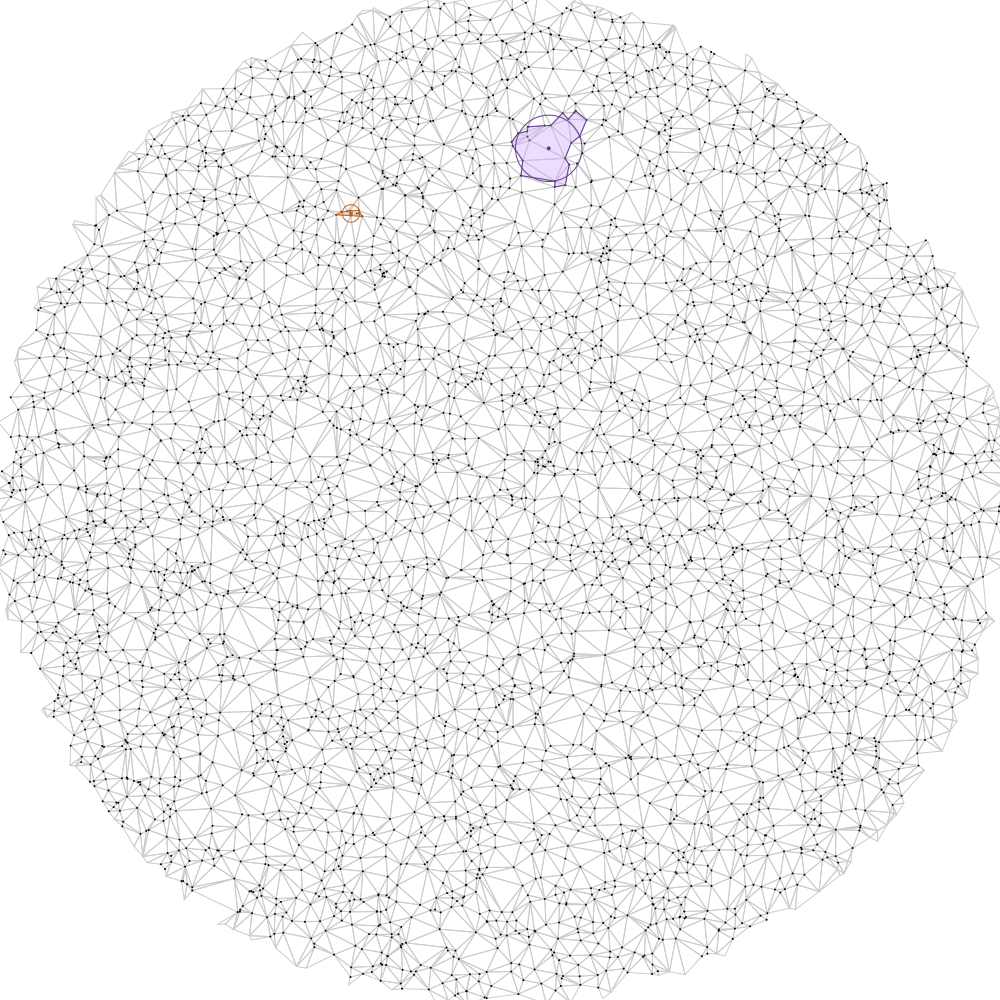
Based on the same mathematical and statistical principles as libAttract I engineered a novel algorithm in the fast, robust and modern Rust programming language. Inspired by the memetic recurrence of cats in void areas of Randonaut trips I called it VOIDCAT, short for Void Objects Identification in Delaunay Complexes with Attractor Tracking.
To implement the Attractor and Void anomaly search I focused on geometric spatial analysis algorithms, particularly utilizing a technique called Delaunay triangulation. The algorithms utilized are primarily the DELFIN algorithm developed in the field of astronomy to map void areas in space and the efficient graph-based spatial clustering algorithm DTSCAN that looks at adjacencies of vertices in a triangulation graph to find clusters in multidimensional point distributions.
While VOIDCAT itself remains proprietary and for Randonautica's exclusive use, I open sourced the Rust implementations of the underlying spatial analysis algorithms in a package called Xenobalanus
Repository